Why Do Poor Social Groups Have More Babies and Rich Social Groups
Michael B. Sauter
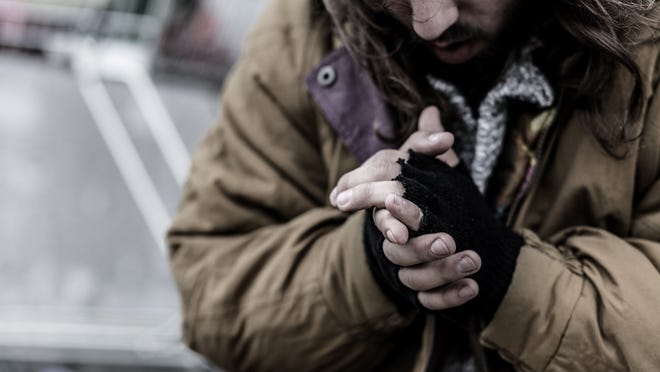

The U.S. Census estimates that 13.4 percent of Americans, about 42 one thousand thousand, lived below the poverty line in 2017.
Of course, poverty is far from evenly distributed across the United States, and depending on a person's race, gender, occupation, and social condition, Americans are far less, or far more than, likely to live in poverty. Some groups are more twice as likely to experience poverty as the average American.
Both personal responsibility and structural pressures tin atomic number 82 to poverty, and experts oft argue which affects poverty more. Merely some factors outside of the control of the individual — including being a woman, black, Hispanic, a child, or a disabled person — are an indicator that one is more probable to live in poverty.
Greg Acs is vice president at the Income and Benefits Policy Center of the Urban Institute, an economic and social policy think tank. Acs helped explicate the complexity of poverty, and why those certain groups are more likely to experience poverty. "The issue with poverty is that it'southward both a crusade and a consequence of factors in the economy and society and personal decisions. So you'll discover some groups that have college poverty rates than others in no small part due to their inability to generate a lot of income on their own as a result of historical, economic, social, and personal factors."
More:Brad Paisley, Kimberly Williams-Paisley to open free grocery store for those in need
More:Wealth in America: Where are the richest and poorest states based on household income?
More:What is the worst metropolis to live in your state? Find out.
24/7 Wall Street reviewed 2017 American Community Data from the U.S. Census Bureau to identify eleven distinct groups of Americans who are more likely than their peers to live in poverty. Information technology is important to note that the more commonly reported poverty rate is based on the Census Agency'south Current Population Survey, but to consistently use the level of detail required to break downward poverty rates for specific groups, nosotros used American Community Survey information in all cases.
Some of the groups on this listing are more likely to grow upwards in difficult homes, poor neighborhoods, and inadequate school systems. They face up discrimination and limited piece of work or advocacy opportunities, and the effects of generational poverty, all which brand it more than likely they will alive in poverty.

eleven. Service workers
• Poverty charge per unit: 10.7 percent
• Total in poverty: 26.2 million
• Service workers every bit percentage of U.S. population: viii.2 percent
• Service workers as percent of poor population: half-dozen.six percent
The 10.ane percent poverty rate amongst service workers might not seem especially high, given that the national poverty charge per unit is 13.4 per centum, but Americans who are employed are far less probable to alive in poverty than those who are not. For example, simply iv.nine per centum of America's total-time workforce lived beneath the poverty line, according to the Bureau of Labor Statistics, half the poverty rate among service workers. Service workers represent a major part of the American workforce, and a large share of service workers earn minimum wage or close to it. Equally of 2017, two-thirds of all American workers earning the minimum wage or less were in service occupations. The electric current federal minimum wage is $seven.25 an hour, which, bold a 40-60 minutes work calendar week, would non be enough to bring an individual with no dependents above the poverty level. Many states and municipalities have already passed, or are currently because passing, legislation to increase the local minimum wage to $15 an hour.

10. Women
• Poverty rate: 14.v per centum
• Full in poverty: 23.vi million
• Women as percentage of U.S. population: 51.0 pct
• Women as percentage of poor population: 55.4 percent
While 12.two percent of men in the U.s. live in poverty, the poverty rate for women is 14.v percent. Because women face up a number of unique challenges they at a greater risk of poverty and financial hardship. Women are paid far less than men — women earned 81.3 percent of men'due south median earnings in the second quarter of 2018. While much of this gap tin exist explained by the kinds of occupations women occupy, the pay gap between men and women persists even when job duties and qualifications are equal. Women with masters and doctoral degrees earn 71.9 percent of what men with a similar education earn, and they are paid less in nigh every occupation. Women are too more probable than men to work in low-paying occupations and spend more time providing unpaid caregiving to children or elderly family unit members.
More:Progress in fighting poverty in America has slowed despite recent economic recovery

nine. Hispanics and Latinos
• Poverty charge per unit: 19.iv percent
• Total in poverty: 11.2 million
• Hispanics and Latinos as percentage of U.S. population: 18.2 percentage
• Hispanics and Latinos equally per centum of poor population: 26.ii percent
Some 19.4 percent of Hispanic and Latino Americans live in poverty, far above the nationwide poverty 13.4 per centum poverty rate for all Americans. Two factors contributing to the loftier poverty rate amid Hispanics and Latinos are the group'due south relatively low education and earnings levels. Just 16.0 pct of Hispanic and Latino adults accept a bachelor's degree, half of the nationwide college attainment rate of 32.0 percent — for all races. Individuals with a college degree are more probable to concur advanced, loftier-paying jobs and report higher incomes overall. In the second quarter of 2018, the typical Hispanic or Latino workers earned only 76.9 percent of the median earnings for all workers.
A large share of Latino workers also face racial discrimination that can reduce the likelihood of gaining employment and ultimately pb to lower earnings. According to a poll conducted past National Public Radio, the Robert Wood Johnson Foundation, and Harvard T.H. Chan School of Public Wellness, one in three Hispanics and Latinos living in America written report being discriminated against when applying for jobs.

viii. Children under v
• Poverty charge per unit: 20.two percent
• Full in poverty: iii.nine 1000000
• Children under 5 as percentage of U.S. population: 6.1 per centum
• Children under 5 as percentage of poor population: 9.ii percent
Children cannot earn incomes on their ain, and then they are reliant entirely on the incomes of their parents to stay out of poverty. Compared to working-age adults or senior citizens, children are significantly more likely to live in poverty — eighteen.4 pct of Americans under historic period 18 alive in poverty, compared to 12.half-dozen percentage of 18 to 64 twelvemonth olds and 9.3 per centum of senior citizens. And the about vulnerable children are the youngest. While 17.8 percent of children age five to 17 live in poverty, twenty.2 percent of children under 5-years-old practice.

7. Not-citizen immigrants
• Poverty charge per unit: 20.four per centum
• Total in poverty: four.5 million
• Not-citizens as percent of U.Due south. population: 7.0 percent
• Non-citizens as percentage of poor population: 10.half-dozen percent
Of the 44 one thousand thousand immigrants to the United States, slightly less than one-half have go citizens. Regardless of citizenship status, foreign-built-in people living in the United States are more probable than natural born Americans to live in poverty. About 20 pct of non-citizen immigrant residents earn poverty wages. Finding steady employment equally an immigrant tin be particularly difficult due to language barriers, bigotry, and more. Permanent employment status tin can assist pave the path to citizenship, which helps explain why those who are not still citizens are peculiarly likely to earn depression wages. The Census is widely believe to heavily undercount those who currently alive in the country illegally, and poverty estimates for this group likely far exceed poverty rate of other immigrant groups.

vi. Black and African Americans
• Poverty rate: 23.0 percent
• Total in poverty: 9.1 million
• African Americans as percentage of U.S. population: 12.5 percent
• African Americans equally percentage of poor population: 21.4 percent
Blackness and African Americans living in the Us face a wide range of institutional obstacles that make earning a steady, livable income, also every bit the possibility of escaping poverty, extremely hard. Black Americans are more than twice every bit probable as whites or Asian Americans to alive in poverty. According to a study past the Brookings Institution, blackness Americans meet inequalities in educational activity, discrimination in the workplace, ineffective parenting, high incarceration rates, and more. One in eight Americans are blackness, but blackness Americans make up more than one-fourth of the nation's poor population.

5. Adults with less than a high school diploma
• Poverty rate: 24.7 percent
• Total in poverty: 6.3 million
• Adults w/o a high schoolhouse diploma as per centum of U.S. population: 8.1 percent
• Adults westward/o a loftier school diploma equally per centum of poor population: 14.9 percentage
While there are several famous Americans who dropped out of high school or college and are now successful billionaires, generally educational attainment is a strong indicator of i's earnings potential. Most jobs that pay above poverty wages require, at the very least, a high schoolhouse diploma, and a large share likewise require a bachelor'south caste. Among American adults, typical earnings correspond directly with educational attainment. The typical adult who did not graduate from loftier school earns $xx,924 a yr, roughly $eight,000 less than median earnings for those graduated loftier schoolhouse merely did not go on to higher education. The typical American with only a bachelor'due south degree earns $51,094 a twelvemonth, over $30,000 more than the median earnings for Americans who have not graduated loftier school.

four. American Indian and Alaska Natives
• Poverty rate: 25.iv per centum
• Total in poverty: 670,571
• American Indian and Alaska Natives as percentage of U.S. population: 0.viii percent
• American Indian and Alaska Natives equally percentage of poor population: one.vi percent
Native Americans are still dealing with the effects of 400 years of persecution and bigotry. At the time of colonization, the U.S. government forced tribes onto remote reservations that often lacked natural resources or arable soil. Today, American Indians have the highest poverty rate of whatever major racial group in the Us, with one in four living beneath the poverty line. Those who live on reservations face up obstacles such as food insecurity and associated health problems like diabetes.

iii. Americans with a disability
• Poverty rate: 25.seven pct
• Total in poverty: 9.vi million
• Disabled equally percent of U.Southward. population: eleven.8 percent
• Disabled as percentage of poor population: 22.6 percentage
As is the example with many conditions associated with poverty, causality goes both means. Those who have a inability have a higher chance of condign poor, and those who are poor have a college risk of becoming disabled. Those with a disability, physical or otherwise, are much more probable to be unable to work. In 1990, the U.Southward. government passed the Americans With Disabilities Act, designed to ensure the financial security of people with a debilitating status or injury. Yet, evidence suggests that workplace discrimination continues, and the disabled generally have a harder time finding steady work and earning to a higher place-poverty wages. The unemployment gap between the disabled and not disabled has actually widened since the ADA was passed.

2. The unemployed
• Poverty rate: 30.four per centum
• Total in poverty: ii.half-dozen million
• Unemployed as percentage of U.South. population: ii.seven per centum
• Unemployed as per centum of poor population: 6.1 percentage
Many people who live in poverty work full- or part-fourth dimension, earning poverty level wages, but ane of the more obvious contributors of poverty is earning no wages at all. Just 4.ix percent of those who were employed at least 27 weeks in 2016 lived in poverty. More 30 percent of Americans who were unemployed and actively seeking work lived in poverty. Those who are unemployed are eligible for state unemployment benefits, simply these are often non enough to escape poverty, particularly if the unemployed person has dependents to support. Those who alive in poverty are also more likely to take difficulty finding employment for many reasons, including the fact that those growing upwards in poverty are less probable to have high school and college instruction.

1. Single recent mothers
• Poverty rate: 44.three percent
• Total in poverty: 592,588
• Single recent mothers as percent of U.S. population: 0.four percent
• Single contempo mothers equally per centum of poor population: 1.4 percent
A dependent child can be a significant price burden, peculiarly for single parent, and is ofttimes enough to push button the parent — often a mother — and kid into poverty. Among recent unmarried mothers, an astounding 44.3 per centum alive in poverty. In comparison, just 11.4 percent of married recent mothers alive in poverty. While an unplanned-for pregnancy can occur among people of all social and economical levels, low-income women take far more than unwanted pregnancies than college-income women. A 2011 study published in the New England Journal of Medicine institute that low-income women were five times more probable to accept an unplanned pregnancy than high-income women.
Detailed findings
Virtually people who live to a higher place the poverty line are able to practice so through their jobs. For this reason, the groups that take higher poverty rates generally are less likely to exist steadily employed, or are less likely to accept high-salaried positions. The disabled and the poorly-educated, for example, are 2 of the virtually probable groups to exist in poverty because they either cannot access sure kinds of jobs or are less attractive to potential high-paying jobs.
The importance of not just existence employed merely also well paid in order to stay out of poverty is evident in the poverty rate amid Americans employed in the service industry, which, at 10.7 pct, is about twice the poverty rate for those who accept jobs. Fifty-fifty full-time service industry workers, many of whom earn minimum wage, often earn poverty incomes.
"In service industries, many of these jobs don't require the highest level of skill or education or training," Acs said. "They do crave a lot of personal responsibility and reliability, but because there'southward a large competitive pool of folks that can do those jobs, and to the extent that those jobs are gendered and there are gender differences that are baked into the manner we value piece of work, those jobs tend to pay less, and hence folks working in those jobs tend to take higher poverty rates."
Many of the groups on this listing are racial or ethnic groups, including black, Hispanic, and American Indians. While the poverty charge per unit for white Americans is around 10 percent, it is roughly double for blackness and Hispanic Americans, and it is 25 percent for American Indians.
Attempting to explain the difficulties in assessing why certain social or economic groups have higher poverty rates, Acs said, "Racial and ethnic differences [in the poverty rate] are really complex." He added that ane major reason for the disparity is that these groups appear to have more express access to opportunities for gainful employment, due in role to, he said "...discrimination, and the long-term structural barriers that bear on the circumstance of the neighborhoods in which African Americans grew upwardly, as opposed to neighborhoods where whites grew up."
For many specific groups in poverty, there is the argument that individuals in loftier-poverty groups did not accept actions that could lift them out of poverty, including obtaining an education and leaving their impoverished neighborhood. "But," Acs noted, "the reason they didn't practice those things was that their poverty or intergenerational poverty reduced those opportunities factors, and society constrains where people can live and what jobs they get offered."
Having a child is a significant expense on a family, and larger families must earn more to escape poverty. Poor families are therefore more probable to be big, and for this reason, children are more likely than both working-age adults and the elderly to alive in poverty.
Single parents, particularly unmarried mothers, are one of the most impoverished groups in America, in part because impoverished Americans are more than likely to have unwanted pregnancies, and also considering supporting a kid with a single source of income is more burdensome on an private, who cannot rely on a partner for flexibility in childcare or income.
Methodology
Based on data from the U.Southward. Demography Bureau and the Bureau of Labor Statistics, 24/7 Wall Street identified population groups that are more than likely to live in poverty compared to other comparable groups. The share of service workers in poverty is based on the July 2018 U.Southward. Bureau of Labor Statistics Report "A contour of the working poor, 2016," which identifies the poverty rate for all workers employed in a profession for 27 weeks or more during 2016. The remainder of information on poverty rates came from the U.S. Census Agency'due south 2017 American Community Survey (ACS) one-year estimates. Average earnings by occupation, sexual practice, and race also came from the 2017 ACS.
24/7 Wall Street is a USA TODAY content partner offering financial news and commentary. Its content is produced independently of USA TODAY.
mcclellansomet1976.blogspot.com
Source: https://www.usatoday.com/story/money/economy/2018/10/10/faces-poverty-social-racial-factors/37977173/

Post a Comment for "Why Do Poor Social Groups Have More Babies and Rich Social Groups"